

Challenges for CEOs in 2025. Global report from the IESF proprietary study
Global markets are becoming increasingly unpredictable, and company CEOs are facing a wide range of challenges. As part of the first edition of the IESF Global CEO Outlook Study 2025, we conducted 640 interviews with CEOs from 18 countries to understand which issues will be most important to them in the coming year.
The results are clear. Challenges for CEOs in 2025 include digital transformation, cost pressure, recruitment difficulties, expansion into new markets, and geopolitical risk. These areas will have the strongest impact on business strategies in the year ahead.
“CEOs around the world are no longer asking whether the business environment will remain volatile. They are asking how to build a company that can maintain profitability and growth despite that volatility.”
IESF Global CEO Outlook Study 2025
CEO priorities around the world
The IESF study shows a shared direction in CEO thinking across regions. Regardless of the market, CEOs are focusing on business resilience, technology, and leadership quality.
At a global level, it is clear that CEO priorities in EMEA, the Americas, and APAC differ in scale, but not in decision logic. Executive teams are looking for a balance between protecting profitability and investing in the future. At the same time, adaptation to changing economic conditions, regulatory pressure, and international instability is becoming increasingly important.
The report Challenges for CEOs in 2025 shows that the most important decisions will concern costs, digital transformation, people, expansion, and risk management. These areas will determine both the pace of growth and the resilience of organisations in the months ahead.

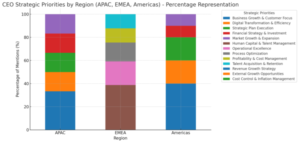
Cost optimisation and profitability
Economic uncertainty is forcing companies to analyse their finances more carefully. Cost pressure remains one of the most important challenges for leadership teams.
Rising operating costs, inflation, and increased investor caution are pushing companies to search intensively for new ways to improve efficiency. Executive teams are reviewing cost structures, renegotiating supplier agreements, and eliminating areas that do not generate enough business value.
At the same time, cash flow control is gaining importance. For many companies, financial flexibility will be just as important as growth in 2025. Technology also plays a growing role here, helping organisations identify savings without reducing service quality or customer experience.
Conclusion for CEOs: to remain competitive in 2025, companies need to find the right balance between cost discipline and investment in innovation, talent, and growth.
Digital transformation and AI
Digital transformation is no longer a side project. For many companies, it is becoming a condition for staying competitive.
2025 will be another year of broader adoption of artificial intelligence, automation, and advanced analytics. Organisations that fail to accelerate their technology investments risk losing momentum against more agile competitors. Today, AI supports not only productivity, but also decision quality, planning, and customer personalisation.
At the same time, digitalisation increases the importance of cybersecurity. The more processes move into digital environments, the greater the need to protect data, infrastructure, and business continuity. Modern technologies therefore cannot be implemented separately from risk management.
Conclusion for CEOs: digital transformation is not only a way to reduce costs. It is also a tool for building competitive advantage and responding faster to market change.
The war for talent
The shortage of critical skills remains one of the biggest challenges in the labour market. Companies are increasingly competing not only with offers, but also with the quality of the working environment they create.
In sectors such as IT, engineering, finance, and manufacturing, it is becoming harder to attract and retain the best people. As a result, organisations are strengthening employer branding, investing in development programmes, and building more flexible working models.
The development of internal talent is also becoming more important. Companies that cannot quickly acquire skills from the market are more often focusing on reskilling, succession development, and stronger leadership pipelines inside the organisation. This is changing both the way recruitment is approached and the role of leaders in retaining teams.
Conclusion for CEOs: retaining and developing talent requires a more deliberate approach to culture, leadership, and career development.
Expansion into new markets
Despite difficult macroeconomic conditions, many companies are still looking for growth beyond their existing markets. Expansion is becoming a way to diversify revenue streams and build resilience.
In practice, this means greater interest in strategic partnerships, acquisitions, and business models that allow companies to scale faster than before. Regions such as Asia and Latin America remain attractive destinations for firms looking for new growth opportunities.
At the same time, expansion requires local knowledge, solid organisational preparation, and a realistic view of risk. Even an attractive market does not guarantee success if a company cannot adapt its model to new local conditions.
Conclusion for CEOs: entering new markets requires flexibility, strong partners, and the ability to adapt quickly to local realities.
Geopolitical and economic uncertainty
International uncertainty is having a growing impact on day-to-day business decisions. Risk management is becoming one of the core responsibilities of the executive team.
Trade wars, political tensions, regulatory changes, and supply chain disruptions mean that companies need to plan more through scenarios than they did just a few years ago. More organisations are diversifying suppliers, reducing dependency on one region, and strengthening their monitoring of the regulatory environment.
An important trend is also the development of predictive models and early warning systems. These enable leadership teams to respond faster to changes before they affect sales, costs, or operational stability.
Conclusion for CEOs: operational security and readiness for different scenarios will be just as important in 2025 as growth and investment.
What a CEO strategy for 2025 may look like
The coming year will bring both challenges and opportunities. The greatest advantage will go to companies that combine adaptability with long-term thinking.
To manage effectively in 2025, CEOs can focus on several areas. The first is the integration of new technologies, including AI, automation, and data analytics. The second is investment in people, because a strong employer brand and leadership development will directly affect the speed of change. The third pillar is risk management, especially in the context of geopolitical instability and regulatory pressure.
A long-term perspective will remain equally important. Companies that think ahead and continue to invest in innovation despite uncertainty are more likely to maintain a leadership position in their industries.
In one sentence, challenges for CEOs in 2025 require executive teams to adapt quickly to market changes, manage talent effectively, and combine financial discipline with development.
Challenges for CEOs in 2025 by sector
Although the main challenges are shared across most markets, their weight differs by industry. In practice, the sector often determines which risk becomes the top priority for the executive team.
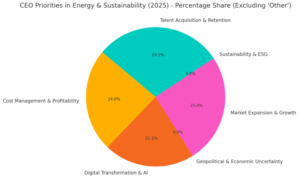
Energy sector
In this area, investment security, the energy transition, regulation, and long-term operational resilience will be especially important.
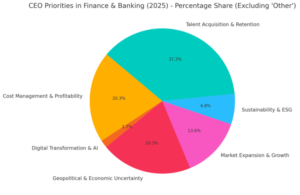
Financial and banking sector
In 2025, the financial sector will focus on digitalisation, cybersecurity, regulatory compliance, and rising customer expectations.
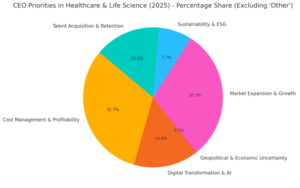
 Pharmaceutical and medical sector
The biggest priorities will include access to specialised talent, the speed of innovation, regulatory compliance, and the stability of supply chains.
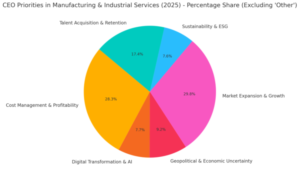
Industrial sector
In manufacturing, energy costs, operational efficiency, labour shortages, and the need to build resilience in a volatile environment will stand out most strongly.
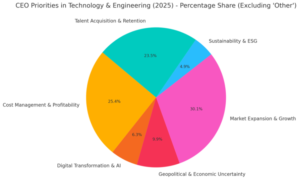
Here, AI, automation, competition for talent, and pressure to test and scale solutions quickly will come to the forefront.
We support business leaders in selecting managers, improving onboarding quality, and developing leadership capabilities so that talent decisions strengthen organisational performance in a measurable way.
Author: Ewa Adamczyk
Sources: IESF Global CEO Outlook Study 2025; user-provided source material.
26 February 2025