
The CEO Outlook for 2026 – Disciplined Execution in an Uncertain World
CEO challenges 2026 are increasingly defined by disciplined execution in an environment that keeps changing.
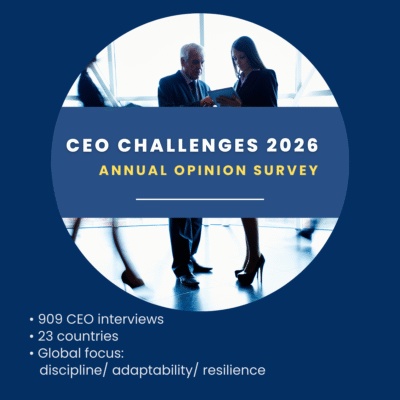
In this article, we summarise the CEO challenges 2026 based on insights from 909 CEO interviews across 23 countries. As a result, you will see the same pressures repeated across markets: protecting profitability, choosing growth carefully, using AI in practical ways, and securing the leadership and skills required to deliver.
- Why this CEO study matters
- CEO challenges 2026 – what 909 CEO conversations reveal
- Profitability and cost discipline – a defining CEO priority for 2026
- Selective growth – how CEOs are reshaping international expansion in 2026
- Practical AI – why digital transformation becomes infrastructure in 2026
- Leadership capability and retention – the execution constraint CEOs cannot ignore
- Central & Eastern Europe – the same agenda, but with sharper trade-offs
- Six CEO decisions that will define 2026
- Summary and next step
- FAQ
Why this CEO study matters
Most CEOs do not wake up and say, “My biggest problem is uncertainty.” They rarely need to, because uncertainty has become part of everyday business. Instead, what matters more is what a CEO builds on top of that uncertainty: a company that remains focused, makes decisions quickly, and delivers results without burning out its people or breaking its operating model.
That is why the IESF CEO Outlook 2026 stands out. It is based on 909 CEO interviews conducted between October 2025 and January 2026 across 23 countries. The study does not try to impress with theories. Instead, it shows how CEOs describe their priorities when they speak about what they really need to get right.
In 2026, many CEOs sound less concerned about choosing the “perfect” strategy. However, they sound more concerned about something more fundamental: whether their organizations can execute reliably under pressure.
CEO challenges 2026 – what 909 CEO conversations reveal
When you look across the interviews, you do not see chaos. You see a pattern. In fact, CEOs return to four connected themes.
They focus on profitability and cost discipline as a permanent leadership responsibility. At the same time, they still pursue growth, but they pursue it more selectively and with clearer risk thresholds. Meanwhile, they treat AI and digital transformation as infrastructure that must improve day-to-day performance. Finally, they describe leadership capability and retention as the factor that often decides whether strategy becomes reality.
These themes are global. However, they take a slightly different shape depending on region and industry, and Central & Eastern Europe adds extra intensity to several of them.
Profitability and cost discipline – a defining CEO priority for 2026
Many CEOs describe cost management in 2026 as something deeper than “cutting costs.” For that reason, they talk about discipline as a foundation that allows the business to stay flexible and to invest with confidence.
This perspective matters because cost pressure is rarely just about expenses. In practice, CEOs often mean something broader. For example, they want to reduce complexity that slows execution, eliminate overlapping initiatives that dilute accountability, improve transparency so leaders can make faster decisions, and protect the investments that truly drive long-term competitiveness.
In other words, profitability becomes a leadership system. As a result, it gives the company room to move when markets shift, when supply chains tighten, or when customer demand changes faster than forecasts.
Selective growth – how CEOs are reshaping international expansion in 2026
CEOs still talk about growth in 2026, including international growth. What changes is the way they define it. Consequently, many leaders are moving away from broad expansion plans and toward growth that is more carefully chosen, better sequenced, and tied to execution capacity.
In practical terms, selective growth usually means three things. The company grows where it can deliver reliably, it expands where risk is understood and managed rather than ignored, and it scales where the leadership bench is strong enough to support it.
This approach is not “playing small.” Instead, it is a recognition that volatility punishes overextension. Growth remains essential, but the CEOs who succeed will usually be the ones who match ambition with operational realism.
It is also worth noting that many CEOs do not separate growth from collaboration. In international markets, growth often depends on partners, networks, and the ability to operate across cultures without losing speed.
Practical AI – why digital transformation becomes infrastructure in 2026
AI continues to be highly visible in CEO conversations. However, many CEOs are moving away from treating AI as a standalone transformation program. Instead, they increasingly treat it as infrastructure that must support day-to-day performance.
This shift changes what CEOs ask for. Rather than asking, “Do we have AI pilots?”, CEOs increasingly ask whether AI improves decisions and execution, whether governance and security are strong enough, whether ownership is clear, and whether adoption and impact are measured rather than assumed.
In many organizations, AI becomes a test of operational maturity. When data is inconsistent, when processes are unclear, or when accountability is weak, AI efforts struggle. Conversely, when governance is strong and priorities are clear, AI becomes a powerful lever for productivity and decision quality.
Leadership capability and retention – the execution constraint CEOs cannot ignore
In 2026, CEOs frequently describe talent not as an HR topic, but as the factor that decides whether strategy becomes reality. Even the best plan will fail if the leadership team cannot deliver it, if critical roles remain unfilled, or if retention becomes unstable in key functions.
Moreover, across markets, CEOs often return to the same questions. They want leaders who can scale teams and make decisions under pressure, they need skills that support growth and transformation, and they must build succession strength in roles that the business cannot afford to lose.
This topic matters even more when a company operates internationally or expands to new markets. In those situations, leadership hiring becomes closely tied to growth outcomes, and the right leaders can reduce risk while accelerating execution.
“What I hear most often from CEOs today is not a lack of ideas, but a lack of capacity to execute without friction. In 2026, the winners will be the companies that simplify, decide faster, and build leadership teams strong enough to deliver under pressure—while staying clear about which risks they accept and which they do not.”
Ewa Adamczyk, CEO / Managing Partner, NAJ International Executive Search
Central & Eastern Europe – the same agenda, but with sharper trade-offs
The priorities described above are global, but Central & Eastern Europe often experiences them with greater intensity. Across Poland, Romania, Hungary, and Czechia, CEOs tend to operate with tighter margins, persistent wage pressure, and higher regulatory volatility. In Poland, geopolitical sensitivity is also a stronger factor in strategic timing and investment decisions.
As a result, the CEO challenges 2026 often feel less theoretical and more immediate. Therefore, leaders in the region usually demand clearer payback from investments, prioritise operational control because risk is harder to ignore, make growth decisions with stronger emphasis on resilience, and treat talent constraints as a business risk rather than merely a recruiting issue.
Many CEOs also revisit a more philosophical question in this environment: when is it right to push forward, and when is it wiser to wait, stabilise, and prepare for better timing?
Six CEO decisions that will define 2026
Because CEO challenges 2026 are so strongly connected to execution, many CEOs benefit from turning insights into explicit decisions. The study suggests that success in 2026 will depend less on bold declarations and more on clear choices that improve focus, speed, and resilience.
If you are a CEO planning the year ahead, these six decisions are worth making explicitly.
1. Decide what to stop
Ask what you will stop doing so that execution can speed up. As a result, when organizations do too many things at once, responsibility becomes unclear and progress becomes slow.
2. Define your growth bets and the conditions for success
Clarify which growth bets you will pursue, and specify what must be true for each bet to work. In addition, selective growth works best when selection criteria are defined in advance.
3. Make AI operational, not symbolic
Identify where AI should become infrastructure, and assign clear operational ownership. Therefore, AI delivers value when it is governed, embedded in processes, and measured through adoption and impact.
4. Protect the roles that limit execution
Define which roles are true bottlenecks, and decide how you will protect them through retention, succession, and leadership development. In practice, execution often fails not because the plan is wrong, but because key roles remain fragile.
5. Set risk thresholds you will not cross
Decide which risks you accept and which are non-negotiable. As a result, risk thresholds guide timing, investment sequencing, and decision speed.
6. Reward reliability under pressure
Decide which leadership behaviours you will reward in 2026. In volatile conditions, reliability becomes a strategic advantage, and disciplined execution becomes a differentiator.
Summary and next step
The CEO challenges 2026 described in the IESF CEO Outlook do not point to one dramatic disruption. Instead, they point to a more demanding leadership reality: execution must become more disciplined, measurable, and resilient, while growth remains necessary and technology remains unavoidable.
If this perspective is useful, the best next step is not to “sell” anything immediately. Rather, a better next step is to deepen your understanding through additional CEO-focused materials. Over time, that learning can help you decide whether a conversation and a contact questionnaire make sense for your situation.
Ewa Adamczyk
Managing Partner / CEO
FAQ
Is 2026 mainly a cost-cutting year?
Most CEOs describe 2026 as a year of structural discipline rather than short-term cost cutting. As a result, they want cost control that protects investment capacity and improves operational focus.
Is growth still a priority for CEOs in 2026?
Yes. Growth remains important, but many CEOs are moving toward selective growth that matches execution capacity and risk thresholds.
How do CEOs talk about AI in 2026?
CEOs increasingly treat AI as infrastructure. In other words, they focus on governance, ownership, adoption, and measurable impact rather than pilots alone.
What is the most underestimated risk in 2026?
Execution constraints are often underestimated, especially leadership capability, key role stability, and internal complexity.
What is distinctive about Poland and the CEE region in this outlook?
The same themes apply, but trade-offs are sharper because leaders operate with stronger volatility and higher geopolitical sensitivity.
- IESF Study 2026 (Based on 909 CEO interviews across 23 countries, Oct 2025–Jan 2026)
- OECD Economic Outlook (General macroeconomic context)
Published: March 2026 | Updated: March 2026