
From Phone Books to AI. How Executive Search Has Changed.
Finding candidates is easier today. Knowing who truly fits is harder. If I had to explain how executive search has changed in the shortest possible way, I would start with the tools we used then and the tools we use now. Research is faster and richer in data, but finding the right leader still takes much more than access to profiles.
- The advertisement that started it all
- First the market, then the names
- Calling the switchboard and finding a way through
- From paper files to responsibility for data
- LinkedIn opened the market
- More profiles do not make the search easier
- AI in executive search is another stage in the same story
- What the history of executive search has taught me
- Executive search is still a very human job
- FAQ
The advertisement that started it all
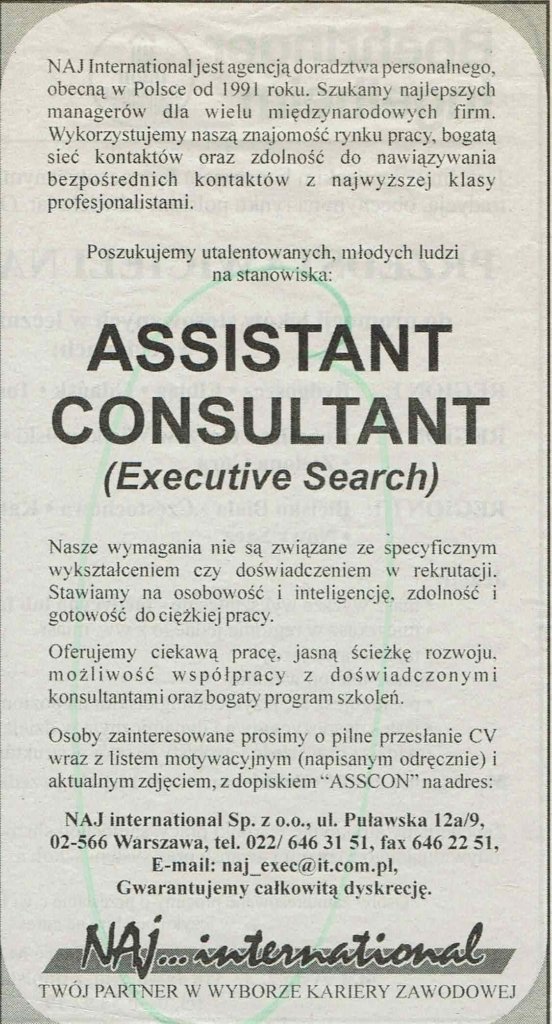
In 1998, my eye caught an NAJ International advertisement in the press. The company was looking for young people for an Assistant Consultant role in executive search. I had no idea that this small moment would shape almost three decades of my professional life, but that is exactly what happened.
There was no requirement for a particular degree or previous recruitment experience. What mattered was personality, intelligence, ability and readiness for hard work. Candidates were asked to send a CV, a current photograph and a handwritten motivation letter. The documents could be delivered by post or fax.
Today this sounds almost like a story from another era. It was the era in which I learned the profession.
I still have the advertisement. It reminds me of my first days at NAJ, but with every passing year I see something more in it. It is a record of a time when executive search looked very different.
There was no LinkedIn, no professional profile search and no sourcing technology. We had a client brief, a conversation with the consultant, a list of companies, industry magazines, phone books and a landline. That was our working world.
The process still began in the same place where I believe it should begin today, with understanding who the organisation really needs.
First the market, then the names
Once we received a brief, we sat down with the role, the scope of responsibility and the client’s situation. Only then did we consider where people with the right experience might be working.
We built lists of companies in the relevant sector, with a similar business model, scale or structure. Specific names appeared at the end of that work, not at the beginning.
It is easy now to type a job title into a search engine and start with the people who appear on the screen. Back then, market knowledge had to be built piece by piece. We learned the companies, their brands, departments, competitors and the people connected with important projects.
The business press was one of our main sources. Every researcher had a set of publications to review regularly. Mine included “Życie Handlowe”, “Computerworld”, “Medycyna po Dyplomie” and “Warsaw Business Journal”.
I read them with a very specific purpose. I looked for people who had moved into new roles, taken responsibility for important projects, appeared as experts or were mentioned in news about company growth.
If the company and the role were relevant to one of our searches, that person went into the candidate database. First we had to check manually whether the name was already there. Sometimes the role was out of date. Sometimes the same function had been entered under a slightly different title.
The system did not recognise duplicates or suggest connections. It certainly did not update itself while we slept. The quality of the database depended entirely on the knowledge and attention of the people who built it.
Keeping information current was part of the research
I once found a sentence in an old instruction for working with the press.
“Newspapers that are not read regularly become useless.”
It sounds almost painfully obvious. Yet it still says something important about research. Information matters when it is current, well chosen and understood in context. Better tools have not made that any less true.
We collected much more than names. We cut out information about companies, potential clients, ownership changes, investments and developments in particular industries. The material went into folders and binders dedicated to companies and sectors. The shelves really did bend under the weight.

When I look at those binders now, I think this image shows how executive search has changed better than many presentations ever could. We keep knowledge differently now and we can reach it much faster. Still, research begins with knowing enough about the market to understand what a candidate profile actually means.
Finding the profile itself may take seconds. Understanding whether the person behind it has the experience a particular organisation needs is another matter.
Calling the switchboard and finding a way through
Phone books were mainly useful because they gave us company switchboard numbers. We called reception desks or secretariats and asked to be connected with someone in a particular function, perhaps a brand manager, a sales director or the head of a department.
It did not always go smoothly. Receptionists and assistants were real gatekeepers. A researcher needed patience, persistence and sometimes a little imagination.
There were days when reaching one person involved several calls and conversations with several different people. You simply kept looking for another way in.
Once we reached the right person, the first conversation was usually short. We explained the role and gave some basic context. If the project was not confidential, we also gave the client’s name.
There were fewer similar offers in the market at the time. An opportunity to join a growing international organisation could be interesting in itself.
The first interview usually took place at the recruitment company’s office. Even the location mattered. It had to be easy enough to reach during the working day, while still offering discretion.
Running into someone from the same industry on the way in could create a very awkward situation.
Today the first contact may happen through LinkedIn, email, phone or a messaging platform. The first conversation may take place online, and candidates have much more freedom to speak from wherever they happen to be.
Reaching people is technically easier now, although getting their attention for the right reasons still takes preparation.
From paper files to responsibility for data
By the end of the 1990s, candidate information lived in two worlds at once.
We were developing an electronic database, but paper CVs, motivation letters, photographs and interview notes were still arriving at the office. Everything had to be organised twice.
During that period, I led the first modification of our CRM system. We wanted it to reflect the way consultants and researchers actually worked and to organise the information collected during projects.
The CRM did not analyse the data for us. It was an electronic store of knowledge created by people. Its usefulness depended on the quality of what we entered.
Some recruitment processes at the time even used graphology as an additional source of information about candidates. Looking back, it feels almost anecdotal now.
Today we use structured assessment tools such as the DISC D3 assessment, which supports the analysis of behavioural style, internal motivation and decision making patterns. This is one of the areas where candidate assessment has changed enormously.
Data responsibility became part of the process
One of the more important projects I managed in those years was the registration of our candidate database with the Polish data protection authority, the General Inspector for Personal Data Protection.
Today we instinctively think of GDPR when personal data comes up. Our responsibility for candidate information began much earlier.
The work involved organising the rules for handling documents and contacting people whose information we already held. We asked candidates for consent to continue processing their data.
Only with time did I fully understand how important that shift was.
A candidate database could no longer be treated only as a business asset. It was also a responsibility towards real people whose private information had been entrusted to us.
As the binders disappeared, that responsibility stayed with us and grew with the volume of information technology allowed us to collect.
LinkedIn opened the market
The arrival of LinkedIn was a breakthrough, although I do not think any of us understood at first how large that change would become.
When I joined, the platform felt almost like a small business club. I got in through an invitation from someone who already had an account. There were not many users. Profiles were sparse, often without photographs or long descriptions, and very little happened there.
Still, seeing people from different companies and markets in one place felt extraordinary.
LinkedIn grew. It stopped being a small professional network and became a global platform where people present their experience, publish, build visibility and develop professional networks.
For recruitment, the practical difference was enormous. Career history, job title and current employer became much easier to check. International projects also became much easier to organise.
Suddenly thousands of professional profiles were visible. What I still needed was the context behind them.
A profile tells me where someone has worked. Yet it may say much less about the influence that person had on the business, the conditions in which they succeeded or the limitations they had to work around.
It does not tell me with certainty what someone needs at the next stage of their career. Nor can it tell me whether the opportunity I am bringing them fits what is happening in their professional life at that moment.
Finding the name became much easier. Understanding the person behind it still takes work.
More profiles do not make the search easier
Today we can identify more potential candidates in a day than we once found in several weeks. Longlists are longer and market access is much wider. In theory, this should make everything easier.
It does not always get us to the right person any faster.
Senior leaders receive many approaches from recruiters. They know their market value and they think carefully about change. A job title, even an attractive one, is rarely enough.
One person may be interested in building a team from the ground up. Someone else may want regional responsibility or the chance to lead a transformation.
Another candidate may be looking for greater influence over decisions. Someone else may turn down an attractive role because they no longer want to work in a business that depends heavily on a foreign headquarters.
Two people with almost identical career histories can react very differently to the same opportunity.
Candidates also look at employers differently now. They ask about the real scope of responsibility, the level of autonomy, the way decisions are made, the relationship with the board or headquarters and the reason the search has started.
They want to understand the conditions in which they will be expected to deliver. The title alone tells them very little.
The organisation is assessing the candidate. At the same time, the candidate is forming an opinion about the organisation, the people involved and the credibility of the process.
A large number of profiles therefore solves very little on its own.
The difficult part comes later. We need to understand the experience behind the profile, the person’s motivation, the possible risks and whether this particular move makes sense for both sides.
AI in executive search is another stage in the same story
I am now involved again in testing new CRM solutions and tools that use artificial intelligence.
From the perspective of someone who started with industry magazines, phone books and shelves full of binders, the scale of the change can still surprise me.
If I had to choose one moment that shows how executive search has changed most clearly, I would probably point to AI.
Artificial intelligence can organise large volumes of information, compare experience, prepare company maps, summarise project material and highlight areas worth exploring in a conversation.
Used well, it removes some of the mechanical work. That gives consultants more time for market analysis, candidate conversations and careful assessment.
I would not ask it to decide who should be recommended for a senior leadership role.
A tool works with the information it receives. Some excellent candidates simply do not spend much time describing themselves online. A polished profile, on the other hand, tells me very little about what someone actually achieved.
The more information technology gives me, the more important interpretation becomes.
A close match to the job description may look reassuring on paper. In practice, I am interested in a different question.
Can this person actually deliver what this organisation needs?
What the history of executive search has taught me
Almost every tool around us has changed.
The phone books disappeared first. Press clippings gradually gave way to digital sources. Paper folders became CRM and ATS systems.
Today even the first meeting may happen online. AI has joined the research process as well.
The job still starts with understanding the client’s situation.
We need to know what kind of experience is genuinely necessary. Then we need to understand where that experience is likely to sit in the market and which parts of the profile really matter.
We still have to separate a well written career history from real achievement. That requires understanding the scale of responsibility, the context in which decisions were made and whether the person is ready for the challenge ahead.
Discretion and trust matter just as much as they did before.
A candidate is not making a decision on the basis of a job description alone. The person running the process matters. So does the quality of the information and the way the candidate’s own professional situation is treated.
We now have more data than I could have imagined when I first joined NAJ. We can reach people faster and map a market in hours rather than weeks.
Sooner or later, however, I still arrive at the same question.
What kind of leader does this organisation really need, and why might this person be the right one?
This is where the tools reach their limit.
Search engines, LinkedIn and AI can give us an enormous amount of information. The final judgement still needs context, experience and a conversation with the person behind the profile.
Executive search is still a very human job
I would not want to return to checking every piece of information manually or to a pile of magazines waiting on my desk. Technology has made the work better in many practical ways.
People have not become easier to understand. Senior hiring decisions have not become risk free either.
I certainly do not want to give up the technology we have today. I want to use it where it genuinely helps. At the same time, I want to leave enough room for judgement, curiosity and real conversation.
When I look back at that advertisement from 1998, I sometimes wonder what my younger self would make of the tools on my desk today.
Probably very little.
I think she would recognise the job itself surprisingly well. She would still need to understand the market, listen carefully and take responsibility for the person she recommends.
That is how executive search has changed over 35 years. Almost everything around the work looks different now. The responsibility for understanding the client, the market and the person is still ours.
Are you planning to hire a leader for your organisation in Poland?
Let’s talk about the market, possible candidate profiles and how to reach people who are not actively looking for a new role.
Ewa Borek
Senior Search Consultant
FAQ
Is LinkedIn enough to find the right executive candidate?
LinkedIn is very useful for identifying potential candidates, but a professional profile does not show the full context of someone’s achievements, motivation or readiness for change. Executive search also involves market analysis, direct contact with people who are not actively looking for a job and an assessment of how their experience fits a particular organisation.
What role does AI play in executive search today?
AI can support research, organise data, help with market analysis and prepare project material. I would not use it as the final judge of a candidate. Experience, motivation, risk and organisational fit still need to be explored through conversation and consultant judgement.
How is executive search different from standard recruitment?
Executive search begins with the market and the business situation rather than with incoming applications. The consultant defines target companies, approaches people who may not be looking for a new role and assesses whether the opportunity makes sense for both sides.
Why does market knowledge matter in executive search in Poland?
For an international company hiring in Poland, market knowledge helps translate a global brief into a realistic local search.
It shows where relevant leaders are likely to work and what level of responsibility may sit behind similar job titles. It also helps us understand expectations around compensation, mobility and decision making authority.
Without that context, even a strong looking candidate profile can be misleading.
How is confidentiality protected in senior leadership recruitment?
The amount of information shared depends on the stage of the search and the arrangements with the client. Candidate data is processed in line with applicable regulations. Information about the project, the organisation and the people involved is shared only when it is necessary.
- NAJ International archival materials
Published: September 2026