
Cross-border projects and international recruitment: what Poland’s IESF journey means for companies hiring confidentially in Poland
Cross-border projects and international recruitment matter far beyond a single assignment. For a CEO, a regional Head of Talent Acquisition, or an HR Director planning a move in Poland, they are a practical way to reduce hiring risk, protect confidentiality, and make better leadership decisions in a new or changing market.
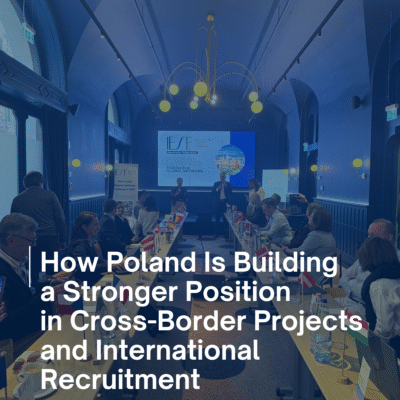
That is why, during the regional International Executive Search Federation conference in Budapest, I did not speak only about projects moving between countries. Instead, I focused on how this type of cooperation matures over time: from early referrals, through periods of rapid growth, to trusted partnerships that support strategic business decisions in Poland.
- Why this matters to international business leaders
- Cross-border projects and international recruitment start with trust
- What Poland’s experience teaches companies entering or reshaping in Poland
- What an international company really gains from the right local partner
- When to speak with an executive search partner in Poland
Why this matters to international business leaders
Cross-border cooperation is no longer a side topic. More often, it is a test of partner quality, execution discipline, and market maturity. This becomes especially important when a company is entering Poland, building a new structure, or preparing for a sensitive leadership change.
From a CEO’s perspective, the challenge is rarely limited to filling a role. The real question is how to make the right leadership decision while balancing local market realities, regional expectations, timing, and business risk. For a regional Head of Talent Acquisition, the priority is slightly different. It is about working with a partner who understands both executive search in Poland and the internal pressure that comes with cross-border decision-making. As a result, this is not only a recruitment topic. It is also a governance, growth, and risk-management topic.
Cross-border projects and international recruitment start with trust
Trust comes first, assignments come later. That was one of the most important ideas in my Budapest presentation. Cross-border work is not simply about passing a contact from one country to another. It is a delivery model in which one partner opens the business conversation and another proves value in the market where the role actually sits.
This distinction matters. If the local execution is weak, cooperation does not scale even when relationships inside the federation are strong. By contrast, when delivery is solid, something more valuable than a one-off success starts to appear. Trust begins to build. Over time, that trust leads to more strategic conversations, more senior mandates, and stronger confidence on the client side.
“In cross-border projects, the goal is not simply to connect two markets. The real value comes from turning trust, local knowledge, and quality of execution into meaningful results for the client.”
Ewa Adamczyk, Managing Partner, NAJ International
This is the right way to look at international recruitment today. It should not be seen as a collection of separate searches. Rather, it should be treated as a mechanism for building business confidence across markets, especially where Poland becomes part of a wider regional or global talent decision.
What Poland’s experience teaches companies entering or reshaping in Poland
Poland did not build its position in international cooperation in a single move. The journey developed in stages, and that is exactly why it is relevant to companies planning growth or change in Poland today. First came a strategic decision, then early assignments, then fast expansion, followed by pressure, slower periods, external shocks, and finally a more mature return of mandates.
That full cycle offers a useful lesson. In the beginning, cross-border activity is often judged in simple terms: how many projects arrived, from which countries, and how quickly they were completed. Later, the real picture becomes clearer. You begin to see which relationships are durable. You begin to see which markets view Poland strategically. You also begin to understand that not every early conversation needs to become a formal assignment immediately in order to create value.
In Poland’s case, projects came from countries such as Germany, the Netherlands, France, Switzerland, Spain, Hungary, Israel, and Canada. That kind of flow does not happen by chance. First, the local partner must prove that they understand the Polish market, can lead a high-level advisory process, and can speak to clients not only operationally, but strategically as well.
Importantly, cross-border projects and international recruitment create value even when they do not lead to an immediate closed mandate. Some conversations return months later. Others mature when investment priorities shift. In other cases, the dialogue itself strengthens Poland’s position as a serious market for future leadership planning.
For companies outside Poland, this matters in a very practical way. Market entry, succession, replacement of an underperforming executive, or a confidential leadership change often begins long before a formal search starts. Therefore, the real advantage lies in speaking with a partner early enough to understand the market, the likely talent scenario, and the reputational risks involved. In many cases, this starts with a conversation about international recruitment in Poland rather than with a formal brief.
What an international company really gains from the right local partner
The biggest benefit is not access to foreign contacts. The real advantage lies in combining local execution with international business context. That is what separates mature cross-border cooperation from a simple referral to a firm in another country.
For a CEO, this means better decisions when the company is entering Poland, stabilising a new operation, or protecting a critical leadership position. For a regional Head of Talent Acquisition, it means lower risk when assessing partners, better preparation for discussions with internal stakeholders, and more predictability in the search process. For an HR Director, it also means a stronger ability to manage sensitive transitions without unnecessary visibility in the market.
This is particularly important in confidential situations. A leadership change in Poland may involve business continuity, investor expectations, board-level pressure, or local reputation. In such cases, speed alone is not enough. The company needs a partner who can translate international expectations into local execution without losing discretion, credibility, or judgment.
In that sense, cross-border projects and international recruitment are not a marginal topic. They form part of a broader conversation about leadership quality, market entry readiness, confidentiality, and organisational resilience in Poland. That is also why many companies review both executive search in Poland and international recruitment options before making a final decision.
When to speak with an executive search partner in Poland
The best moment to start the conversation is earlier than most companies expect. Not when the process is already under pressure, but when leadership sees that the decision will have a cross-border dimension. The earlier the right partner is involved, the stronger the business scenario usually becomes.
This conversation makes sense when a company is preparing to enter Poland and needs a leadership view grounded in the local market. It also makes sense when a regional structure wants to compare options across countries before launching a formal process. In addition, it is valuable when a business needs to assess whether a confidential change at the top can be handled discreetly and realistically.
In those situations, the discussion is not only about candidate availability. It is about scenario planning, timing, stakeholder alignment, and execution risk. That is why many international companies benefit from speaking to a partner in Poland before they officially start a search. The next step can simply be a direct conversation with NAJ International.
To close with one thought: cross-border projects and international recruitment are often a strong indicator of partner maturity. They show whether a firm can operate not only locally, but also within a model built on trust, quality, discretion, and accountability across borders. For companies entering Poland or planning a confidential leadership change, that difference is not theoretical. It is business-critical.
Ewa Adamczyk
Managing Partner, NAJ International