
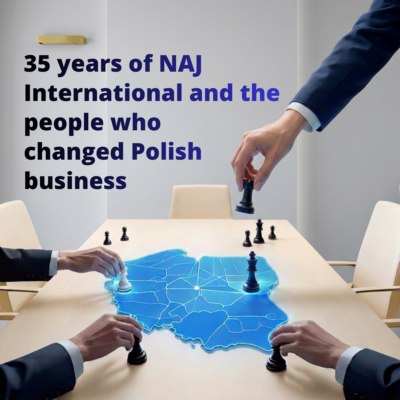
35 years of NAJ International and the people who shaped Polish business
35 years of NAJ International tell the story of Poland’s business transformation through the people who built companies, teams and new management standards. This is not only the history of one executive search firm. It is also the story of a market in which leadership became a source of lasting advantage.
When the company was founded on 22 August 1991, Poland was entering a new economic reality. International organisations were opening local operations. Meanwhile, modern executive search was still unfamiliar to many employers and candidates.
- When modern Polish business was only beginning
- How a letter of intent changed candidate communication
- Poland’s transformation reflected in leadership recruitment
- What three decades of change reveal about the market
- Why technology has not replaced conversation
- How expectations of leaders have changed
- Why trust remains the most valuable capital
- Two decades of responsibility for further growth
- What this means for international employers
- Summary
- FAQ
When modern Polish business was only beginning
At the start of Poland’s transformation, companies did not lack ambition. They lacked leaders ready to work without established structures or tested local models.
International organisations were opening sales offices, factories, logistics centres and local management teams. However, the market had not yet developed reliable ways to identify managers who could connect Polish realities with global standards.
This was the environment in which François Nail founded NAJ International. His goal was not simply to establish another recruitment business. More importantly, he introduced a way of working based on confidentiality, responsibility and partnership.
For foreign investors, that combination mattered. They needed people who understood local conditions and could operate within an international corporate environment.
The challenge was not merely to fill a role. It was to find people capable of building organisations in a market still taking shape.
“François Nail holds a special place in the history of our company. He had the courage to establish NAJ International when the market was only beginning to emerge. He also built standards that remain relevant today: professionalism, confidentiality and a partnership-based approach to the client.”
Ewa Adamczyk, Owner & Managing Partner, NAJ International
More information about the company’s origins and current team is available on the About NAJ International page.
How a letter of intent changed candidate communication
One early challenge was helping Polish candidates explain their professional value to international employers.
Today, a concise CV and a clear explanation of motivation are standard. In the early 1990s, the situation was different.
Many candidates submitted detailed personal biographies. They described their education, family background, employment history and major stages of life. These documents were often sincere. Yet they did not answer the questions becoming important to international organisations.
What can this person deliver? What are their strongest capabilities? What motivates them? Why are they interested in this role? How could they contribute to the organisation?
Polish specialists and managers had experience, ambition and considerable potential. However, they did not always have the tools to present that potential clearly.
Therefore, NAJ International developed its own letter of intent template. The company was also among the organisations that promoted this form of candidate communication in Poland. Preserved archive materials document this work.
In practice, the document resembled what many employers now call a structured motivation letter. It helped candidates explain not only where they had worked, but also how they viewed responsibility and development.
The letter changed the focus from employment chronology to professional identity and motivation. As a result, candidates were no longer presented as a collection of dates and titles.
For international employers, this made assessment more meaningful. It offered early evidence of self-awareness, communication skills and readiness for greater responsibility.
“Polish candidates had enormous potential. They often lacked only the tools to present it effectively. That is why we created a letter of intent template that helped them explain who they were professionally, what strengths they brought and how they wanted to develop.”
NAJ International
Poland’s transformation reflected in leadership recruitment
Changing recruitment needs record how the Polish economy developed. Each stage of growth created demand for new capabilities and greater leadership responsibility.
Initially, companies needed specialists in sales, finance, accounting and logistics. Later, investment increased demand for production, quality and purchasing managers. As organisations matured, they recruited plant managers, functional directors, board members and chief executives.
At the same time, the position of Polish managers within international structures changed. In the early years, expatriates often held the most senior roles in new subsidiaries. Today, Polish leaders manage regional businesses, European functions and global projects.
This was not simply a change in job titles. Instead, it marked a gradual rise in the influence and credibility of Polish leadership.
Local teams stopped only implementing strategies designed elsewhere. They began shaping those strategies, managing investments and taking responsibility across several markets.
The development of executive search in Poland therefore reflects a broader business transition. It shows how Polish managers gained experience, confidence and authority.
For international companies, this shift matters. Poland is no longer only a source of operational talent. It offers leaders capable of influencing regional and global decisions.
What 35 years of NAJ International reveal about market transformation
Economic transformation does not happen through investment figures or strategy documents alone. It happens through the decisions of specific people.
At first, many organisations focused on establishing operations and transferring knowledge from mature markets. Later, they professionalised processes, expanded production and strengthened local management teams.
A deeper change followed. Polish leaders were no longer seen mainly as executors of plans prepared by headquarters. Instead, they began defining priorities, leading international teams and guiding organisations through acquisitions, succession and uncertainty.
Meanwhile, expectations of executive search partners also changed. A list of candidates was no longer enough. Clients increasingly expected market insight, risk assessment and a well-founded recommendation.
The role of an executive search partner became more advisory and more accountable. This mattered whenever a leadership decision could affect an investment or transformation programme.
The history of NAJ International is therefore part of a larger story. It reflects Poland’s development from an emerging investment destination into a mature leadership market.
Why technology has not replaced conversation
Technology has accelerated executive search, but it has not solved its hardest problem. It still cannot assess how a person will act when judgement and accountability are required.
LinkedIn, video interviews and artificial intelligence have made professional information easier to access. They also help consultants compare profiles and map candidate markets.
However, more data creates a greater need for interpretation. A profile can show where someone worked. It cannot fully explain why they made certain decisions or how they respond under pressure.
The value of a consultant does not come from access to names alone. It comes from asking the right questions and understanding the answers.
Technology can identify patterns. Nevertheless, it cannot take responsibility for deciding whether a candidate is ready to lead major change.
For this reason, conversation remains central to executive recruitment. It reveals motivation, judgement and self-awareness.
“CVs show the past. LinkedIn shows experience. AI helps us analyse data. However, none of these tools can answer how a candidate will behave when they face the most difficult decision of their career. We can still explore that only through conversation.”
Ewa Adamczyk, Owner & Managing Partner, NAJ International
How expectations of leaders have changed
The most significant change of recent decades has not been technological. It has been the expanding responsibility expected from leaders.
In the past, a chief executive or director was mainly expected to deliver results. Performance remains essential. Yet it is no longer enough.
Today’s leaders must understand strategy, operations and financial performance. At the same time, they must guide people through uncertainty and communicate difficult decisions.
The pandemic, supply chain disruption, the war in Ukraine, the energy transition and artificial intelligence created situations without complete procedures.
As a result, leaders often had to act with incomplete information. They needed to explain risk, maintain trust and keep teams engaged.
Leadership has become both more strategic and more human. Organisations still need strong results. However, performance without trust and resilience is difficult to sustain.
For international employers recruiting in Poland, this changes the assessment process. Relevant experience matters, but judgement and cross-cultural leadership matter as well.
More information about leadership recruitment and succession is available in the profile of Ewa Adamczyk.
Why trust remains the most valuable capital
In advisory services, trust takes years to build and can be lost through one poorly handled decision.
Over the decades, NAJ International has worked with international corporations, family-owned businesses and organisations from many industries.
However, the greatest value was not simply the number of completed assignments. More important were the clients who returned with further board and leadership decisions.
Candidate trust mattered just as much. Senior professionals shared information about their ambitions, concerns and career choices.
Such relationships cannot be created through an efficient tool alone. They require confidentiality, honesty and the courage to communicate difficult observations.
Trust within the organisation was equally important. Consultants, researchers, administrative employees, partners and interns all contributed to NAJ International’s 35-year history.
This story is not made up of dates alone. It is the sum of professional relationships that remained strong through market change.
Two decades of responsibility for further growth
Since 2005, Ewa Adamczyk has led the company’s continued development. This period represents more than half of its history.
During that time, competition from providers working on a success fee basis increased. Clients also expected greater speed and accountability from recruitment partners.
NAJ International continued to work in a retained search model. This approach is based on exclusivity, full commitment and responsibility for the complete process.
One of the most difficult periods was the COVID-19 pandemic. Many organisations suspended recruitment activity, creating a situation the market had never experienced.
Therefore, the most important decisions were not limited to individual assignments. They concerned people, stability and readiness for the return of client demand.
During 35 years of NAJ International, the company changed with its clients without abandoning responsibility for relationships and process quality.
It also completed its own transformation. The business moved from a mainly Polish focus to assignments across multiple international markets.
Joining the International Executive Search Federation was an important stage of that development. IESF connected detailed knowledge of Poland with trusted partners in other countries.
Consequently, the company could support clients whose teams and ambitions extended beyond one market.
“Since 2005, I have had the privilege of leading the continued development of NAJ International. This represents more than half of the company’s history and a period in which the executive search market changed as profoundly as the organisations we advise.”
Ewa Adamczyk, Owner & Managing Partner, NAJ International
What this means for international employers
Recruiting in Poland requires more than access to candidate profiles. It requires an understanding of the local leadership market and international reporting structures.
The strongest candidates often combine both perspectives. They understand Polish business realities and know how to translate global objectives into local decisions.
However, the market is not uniform. A new market entry requires a different leader from an established subsidiary or a regional structure.
Therefore, a successful search begins with business context rather than the job description alone. The organisation must define what the leader is expected to build, change or protect.
This is where local knowledge and international reach must work together. A search partner should assess candidates in Poland while understanding cross-border mobility and expectations from headquarters.
For this reason, international employers benefit from a partner who can connect Executive Search in Poland with International Recruitment through IESF.
Summary
The history of Polish business is the history of people who accepted responsibility for change. Companies can revise strategies and technologies, but leaders turn decisions into reality.
That is why 35 years of NAJ International should be read as a story about market maturity, leadership and trust. It also shows that organisational success still depends on people who can guide others through uncertainty.
“After 35 years, I remain convinced that people are still the most important investment an organisation can make. Strategies, processes and technologies can change, but leaders make those changes real. I would like to thank our clients, candidates, partners and every current and former member of the NAJ International team. This story has continued because of you.”
Ewa Adamczyk, Owner & Managing Partner, NAJ International
Are you planning a CEO succession, a board appointment or the recruitment of a transformation leader? Discuss your leadership search with the NAJ International team.
Ewa Adamczyk
Owner & Managing Partner, NAJ International
FAQ
When was NAJ International established?
NAJ International was established on 22 August 1991. At that time, Poland’s modern recruitment market and executive search standards were only beginning to develop.
Why is the company’s history relevant to international employers?
It shows how Poland’s business environment, leadership market and recruitment standards have changed since 1991. It also explains the growing role of Polish executives in regional and global organisations.
Why was the letter of intent important?
It helped candidates explain their motivation, strengths and professional direction. As a result, international employers could assess more than a chronological employment record.
Has technology changed executive search?
Yes. Technology has accelerated research, market mapping and profile analysis. However, conversation and organisational context remain essential.
What distinguishes contemporary Polish business leaders?
Many combine local market knowledge with international management experience. They increasingly lead regional teams and cross-border projects.
How does IESF support international recruitment?
IESF connects local executive search partners in multiple countries. Therefore, assignments can combine local market knowledge with coordinated cross-border delivery.
- NAJ International archive, materials concerning the company’s activity since 1991.
- NAJ International archive, letter of intent template and related materials from the early 1990s.
- About NAJ International (company history and team information).
- Ewa Adamczyk (professional profile and leadership experience).
- International Recruitment through IESF (international executive recruitment services).
- International Executive Search Federation (international partner network information).
Published: August 2026