
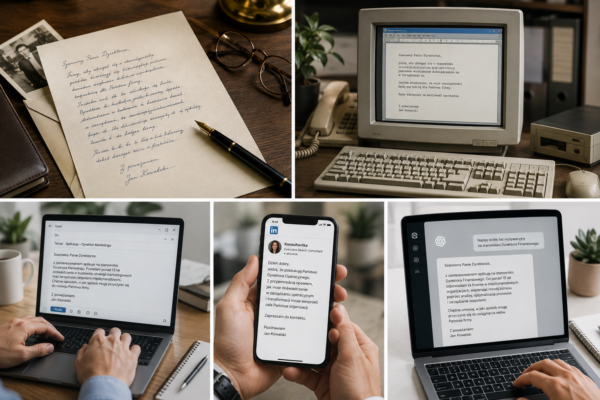
Cover Letter Then and Now After 35 Years in Headhunting
A cover letter in Poland has travelled a long way, from a handwritten document that could be sent to a graphologist to a short message often prepared with AI. It has not disappeared completely, but it has lost its former character. Then and now, it only makes sense when it adds something that the CV does not show.
Over 35 years, recruitment tools, pace and candidate expectations have changed. One thing has not. A company still wants to know why this particular person can solve a specific business problem.
What did an application letter look like in the early 1990s?
At the beginning of the Polish headhunting market, the letter was a formal document and evidence of professional awareness. It was not enough to write that the candidate enjoyed working with people and learned quickly. Candidates were expected to present their own career idea, explain the value they could bring to the company and clearly ask for a meeting.
An archival NAJ International template from that period shows this logic very clearly. The document began with the candidate’s details, the date and a salutation addressed to a specific person. It then included one introductory sentence, two or three paragraphs of explanation, a concluding sentence with a specific request and a signature.
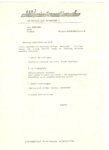
An archival NAJ International template showing how an application letter was structured at the beginning of the Polish headhunting market.
Interestingly, the old format was not excessively long. On the contrary, it required discipline. The candidate had to explain the purpose of the contact, demonstrate value to the organisation and define the expected next step.
Why did handwriting matter?
At NAJ International, we treated handwriting as an additional source of information about a candidate. Therefore, we often asked candidates to prepare the document by hand and passed the sample on for graphological analysis.
Today, this may sound like a mixture of recruitment and fortune-telling. However, in the 1990s, the approach had its supporters. Handwriting was believed to reveal personality traits, working style, resilience under pressure and even relationships with other people. Naturally, some people rejected these claims.
Still, there is no reason to judge past practices with a sense of superiority. Every period uses the tools it trusts at the time. Only experience and observation show which methods genuinely support better decisions.
What did a cover letter reveal about a candidate?
In the past, the content was not the only thing that mattered. The care taken in preparing the entire document was also important. The page layout, form of address and signature indicated whether the candidate understood the principles of professional communication.
The archival NAJ template did not encourage unsupported self-praise. Instead, it recommended describing the candidate’s career idea and the specific benefits they could bring to the department and the company.
Candidates were not expected merely to explain who they were. They had to show why the company should invite them to a meeting.
During the early years of the executive search market, access to information was limited. There were no professional profiles updated in real time, no portfolios available through a single link and no range of digital communication channels.
One document therefore performed the role now divided among a CV, LinkedIn profile, message to a consultant and initial interview.
How did the internet change application documents?
The internet made applications easier to send, but it also reduced the value of many letters. Once a document could be copied, the company name changed and the same text sent many times, a personal declaration quickly became a standard attachment.
Ready-made templates appeared. With them came sentences about dynamic environments, new challenges and the ability to work both independently and as part of a team.
Candidates began to sound remarkably similar, although each of them claimed to be unique.
At the same time, professional CVs became more specific. They started to show achievements, the scale of responsibility and measurable results. It is therefore worth reviewing the guide to writing a professional CV at different career levels: Professional CV for Different Career Stages
The more information a well-prepared professional profile provides, the less reason there is to repeat the same points in an additional document.
What did LinkedIn and AI do to application letters?
LinkedIn moved career stories into the public space, while AI now helps us create many types of text. Today, a candidate can generate a polished statement tailored to a job advertisement within minutes.
The problem is that the recruiter also knows how easily it can be produced.
This does not mean that AI tools are useless. They can help organise arguments, shorten the text and remove awkward wording. However, they should not invent someone’s motivation.
When it is still unclear why a candidate wants a particular role after reading the document, technical correctness cannot save it.
For senior executives, the consistency of the full career narrative now matters more. A CV, professional profile, interview style and reasons for making a change should all tell the same story.
The guide on how to write an effective C-level executive CV may also be helpful: How to Write an Effective C-Level Manager CV
When does such a document still make sense?
An additional text is useful when it explains a decision that cannot be understood from the employment history alone. It may concern a change of industry, a return to the job market, relocation or a move from a corporation to a family-owned company.
Sometimes it also helps explain the conscious decision to accept a position with a smaller scope of responsibility. On a CV, this may look like a step backwards. In reality, it can be a move towards a better fit, greater influence or a different model of professional life.
In such situations, a cover letter should not read like a school essay. Three elements are enough. First, the candidate should explain why the role is of interest. Next, they should connect their experience with the company’s challenge. Finally, they should show why the change is logical at this particular moment.
A short, personalised message to a consultant can also work well. Sometimes four specific sentences are more convincing than a full page of carefully polished declarations.
Authenticity does not mean writing without preparation. It means using arguments that could not be sent unchanged to any company.
Summary
A cover letter can still be useful, but only as a source of specific information. It may take the form of a message to a consultant, sent by email or through another communication channel. When it is sincere and meaningful, it has a chance to attract the recipient’s attention.
Most importantly, it should answer three questions: why this candidate, why this organisation and why now? It must sound like the voice of a person who understands their own career decision.
Is it worth writing one? Yes, in justified situations, preferably as a direct message addressed to a specific person.